- Ongwen Laodog
- Posts
- Not Your Normal News (Feb.2026)


Ongwen Laodog (Not Your Normal Newsman)
Dear reader,
If you’ve been wondering where Not Your Normal News disappeared to in January, here is the 1simple truth: life happened—Ugandan style.
An equipment breakdown took me offline at a critical moment, and just as I was finding my footing again, the internet went dark as the country entered a tense national election period. By the time connectivity returned and systems were restored, January had quietly slipped past.
But stories don’t run on election calendars or internet shutdowns. They wait.
So this February edition arrives not as a continuation, but as a return—to the things that matter, the things we are quietly losing, and the ideas still worth arguing about.
In this issue, we travel backward and forward at the same time.
We revisit the four old Lango divisions—Jo Aber, Jo Moita, Jo Kidi, and Jo Burutok—names that once shaped how people understood land, leadership, ceremony, and belonging, and which now survive mostly as jokes in bars or half-remembered phrases from our elders.
We pause to reflect on a speech about Lira City that was written for an election season that has already passed, yet still asks uncomfortable and necessary questions about vision, leadership, and what we really expect from those we elect.
We laugh—because we must—at how a brutally honest funeral speech in Amolatar accidentally gave birth to “Piny Ler Alera,” Lango’s newest slang, reminding us that language is alive, mischievous, and often born in the most unexpected places.
And finally, we head east to Kwania, where something quietly beautiful is happening: a district beginning to imagine itself differently, starting with a hidden rock that may just be the rooftop from which Lango’s tourism future is first spotted.
Taken together, these stories are not random. They are connected.
They are about identity, memory, ambition, and place.
About what we inherit, what we forget, and what we choose to build.
Thank you for waiting.
Thank you for reading.
And as always—welcome to Not Your Normal News.
— Ongwen Laodog
Four Lango Divisions We’ve Almost Forgotten—and Why They Still Matter

A Lango man of the 1800s
When growing up, every once in a while, I could hear elders remarking about a visitor who had come to visit and was offered the dish of tilapia: “Man a’Moita, pe ngeo camo wi apok. Tin opwonye kede camo wi apok.” Translated: “This is a Moita—he doesn’t know how to eat the tilapia head. Today we shall teach him how.” There would follow a good-natured laugh, and the visitor would enjoy the meal.
Although it has now almost been forgotten, before the coming of the British colonial government to Lango, the region had four major divisions: Jo Aber, Jo Moita, Jo Kidi, and Jo Burutok.
These references have now largely faded. We no longer refer to each other in these terms, but in the past, these divisions were real and meaningful.
These were geographical identities. Johan Andrew Tosh, in his PhD thesis Political Authority Among the Langi of Northern Uganda, suggested that these divisions were once led by powerful war leaders. “In many parts of Lango, stories are told about great leaders of old who were respected over a wide area—men like Opyene Nyakanyolo, Ngora Akubal, Ogwal Abura, and Agoro Abwango.” He adds that the scale of Lango military campaigns in the 19th century shows the importance of these regional structures.
Jo Aber lived north of River Okole; Jo Moita lived between River Okole and Lake Kwania; Jo Burutok occupied Amolatar and Dokolo; while the eastern lands of Lango were home to Jo Kidi.
According to J.H. Driberg in The Lango: A Nilotic Tribe of Uganda, Aber and Kidi appear to be old Lango words meaning “West” and “East.” Moita and Burutok were older words—already falling out of use in the 1920s—that referred to the “South.” Some historical records suggest Burutok may have been the name of a forgotten war hero.
The main differences between these groups were geographical—but also spiritual and ceremonial. The structure of rainmaking rituals differed from group to group.
Before the main rainmaking event, elders held a weeklong “school” known as Eworon, derived from the word woro—“respect.” Boys were taught respect for elders, the duties of citizenship, hunting lore, the art of fighting, the traditions of Lango, and finally, the mysteries of rainmaking, including the dances and songs of their group.
Each division held this elaborate ceremony in its own sacred place: • Jo Burutok at Ekwera in Aduku • Jo Kidi at Abako • Jo Moita at Alipa (location still uncertain) • Jo Aber is said not to have held this festival for reasons unknown
These old divisions may no longer shape everyday identity, but they live quietly in our stories, jokes, and memories—like that timeless moment when someone is called “a Moita” at the dinner table for mishandling a tilapia head. They remind us that Lango was once a region richly defined by geography, ceremony, and shared tradition.
By Ongwen Laodog
Why This Speech About Lira City Still Deserves to Be Read

Lira City
Below is a speech I wrote as a form of personal protest.
For a long time, I have felt that many of our local politicians miss the very point of why they are elected into office. At the same time, the electorate itself often seems unsure about what exactly to expect from its local leaders.
To me, a local leader—especially a mayor—should play a strategic and visionary role, while leaving the tactical, day-to-day running of the city to the employed civil servants whose job that is.
Sometime last year, in the run-up to the Lira City mayoral election, I wrote this speech with the hope of publishing it early enough to offer an alternative way of thinking about the message and the questions that should shape such an election.
Unfortunately, a combination of very human—and very Ugandan—circumstances got in the way. An equipment breakdown took me offline at a critical moment. Soon after, as the country entered a tense national election period, the internet was shut down by government, a familiar precaution driven by fears of post-election violence. By the time connectivity returned and systems were restored, the mayoral election in Lira City had already been held and concluded, with Sam Atul declared the winner.
So why publish this now?
Because while elections come and go, ideas do not expire on polling day.
The speech you are about to read was written as a campaign message, yes—but more importantly, it was written as a statement of belief about Lira City: its history, its character, its people, and the kind of future it deserves. The questions it raises—about vision, ambition, leadership, and the soul of the city—remain just as relevant today as they were during the campaign.
I am publishing it now not to relitigate an election, but to preserve an idea.
Because cities are not built by winners alone.
They are built by conversations.
And this is a conversation still worth having.
Below is the full speech.
My people of Lira City—good evening.
Let me begin with a story.
It was an August mid-morning in 1911. That might seem like a long time ago, but in historical terms, that’s not that long. The sun was already high, burning gently over the grasslands where Lira Modern Primary School stands today. A lone British officer, known by the names G. P. Jervoise, stood supervising a small army of Baganda agents erecting a cluster of canvas tents. To them, it was just another post they were building—another administrative outpost carved out of a vast land they barely understood. They were erecting the new district headquarters, having just moved it from Kwania.
But to a group of curious, stark-naked Lango youths who gathered around, this was something new—something strange—something big.
Jervoise turned to one of the Baganda agents who understood a little Leblango and asked, “Who are those young men?” The agent asked the youths, “Wun jo mene?”
And like the chorus of a well-taught song, they replied together:
“Wan o’jo Alira.” We are the Alira people.
They did not know—and Jervoise did not know—that in that simple answer, in that proud declaration of identity, they were naming a future city. A BOLD and beautiful city. They were naming a future powerhouse. The trading heart of Northern Uganda. A home for dreamers, innovators, entrepreneurs, farmers, teachers, builders—and yes—hustlers.
For from that day, the post was named Lira—after the Jo A’Lira clan whose footsteps shaped the ground beneath what we call Lira City today.
From 1911 to 1919, when Lira became a town council, to 1985 when it became a municipality, to the moment we stand in today as a city—Lira has grown not by chance but by character.
By determination.
By grit.
By hustle.
And that is the spirit we must honor today.
That’s the spirit that beckoned pioneer traders and service providers like Enyang Gabolyeri and Madhvani to Lira.
It’s the spirit that has beckoned you and me standing here today.
THE HEARTBEAT OF NORTHERN UGANDA
Today, many people look at Gulu as the traditional administrative capital of Northern Uganda—and that is true and we celebrate that. But those who truly know the north… those who have traded here, schooled here, healed here, worshipped here… they will tell you:
Lira has always been the true heartbeat of Northern Uganda.
The economic engine.
The cultural melting pot.
The medical and educational lifeline.
The crossroads through which the region breathes.
But my friends, let me also speak the truth:
For too long, our leaders have not told this story.
They have not spoken boldly enough about Lira’s potential—its business muscle, its talent, its promise.
Instead, every election season, we hear the same song: garbage collection.
And yes—garbage must be collected. Our streets must be clean. Our markets must be safe.
But that is tactical work—the work of the City Clerk, the Division Clerks, and their teams.
What we need in our mayor today is strategic vision.
A mayor who sees beyond the dustbin.
A mayor who fights for the soul and future of this great city.
A mayor whose vision is to build a strong middle class, for it is the middle class that has the spending power to quickly move this city forward.
When elected, my administration will work to attract at least 5,000 people who are paid from three million shillings monthly. That’s the true middle class I am talking about. How exactly will I do that? I will tell that to our business people when I speak to them in a few days’ time.
LIRA: THE HUSTLER’S CITY
My friends, let me tell you something powerful:
Lira is the Hustler’s City.
Not hustler as in trickster—but hustler as in dreamer.
As in someone who wakes up early, rolls up their sleeves, and says,
“I am going to make something of my life.”
This has always been our identity.
Look at Madhvani—before he became the industrial giant of Uganda. He started as a hustler from here in Lira and was able to build one of the biggest sugar businesses in East Africa.
Look at Devjibhai K. Hindocha, who built the great Miwani Sugar Mills in Kenya. He was a hustler here in Lira too.
They all began right here—in Lira.
Small traders with big dreams.
Hustlers who refused to accept limits.
And today, thousands of young people—boys and girls not only from Apac, Kole, Alebtong, Otuke, Dokolo, but also from Bugisu, Buganda, Ankole, from Kenya, from India and Pakistan—continue migrating to Lira for one reason:
This is where dreams come to be tested.
This is where ambition meets opportunity.
This is where hustlers rise.
A CITY THAT MUST THINK BIG
When you elect me, I will not lead Lira with small dreams.
I will not shrink our vision to garbage trucks and brooms.
No.
I will think big.
Because Lira is big.
Its people are big.
Its future is big.
As one of my BIG moves, I will seek consensus with Lira District and Kole District so that, together, we can form a unified metropolitan vision. If the people and leaders of these two districts will buy my vision, we shall then ask the central government and the Parliament of Uganda to combine these three local authorities—Lira District, Kole District, and Lira City—into one BIG Lira City. This may not be an easy vision to build consensus around and attain, but should it be attained, it will give us a larger canvas on which we can paint the picture of a BIG and BOLD tomorrow.
A city with:
• Three central railway terminals to unlock trade
• Three airports, including one international gateway airport
• Efficient transport that connects every village and every market
• Smart financing, including something that has never been tried anywhere in Uganda—a municipal bond
• A master plan based on data, direction, and dignity
This is the BIG and BOLD Lira we must build so the hustlers have more options to test and build their dreams.
A CITY OF TECHNOLOGY & AI
We are standing at the door of a new world—an AI world.
And right now, in East Africa, no city has stepped up to claim the title of The AI Capital of East Africa.
But why not Lira?
Why not us?
My administration will:
• Build the first AI and e-commerce hub in Northern Uganda
• Partner with telecoms to bring fast, reliable 5G to bolster e-commerce
• Work with Lira University to create research partnerships in the field of AI and Machine Learning
• Incentivize AI and tech startups
• Equip our youth to become the digital hustlers of the future
How exactly we shall do that, I will be addressing university students in the coming weeks, and I will outline the blueprint to them.
If Madhvani and Hindocha, Opion Owuor and Elyak Kelemene could hustle through trade in the 20th century…
Our children will hustle through AI in the 21st.
A MAYOR WHO LISTENS
When elected, I will embark on a listening tour across the region and beyond—district by district, municipality by municipality.
I will meet:
• Traders to find out what challenges they face whenever they come to Lira City to do business
• Farmers to find out how best to align them with better markets
• Teachers to see how best we can equip our young learners for the AI revolution
• Cultural leaders to find out how best we can make Lira City the cultural melting pot of Uganda
• Business owners to see how best Lira City can help them do even better business
• Local officials to find common grounds on moving the “new vision” I am proposing forward
From Kaberamaido to Amolatar, from Dokolo to Oyam, from Katakwi to Kotido—
I will ask the difficult questions:
Why are the traders of Amolatar and Kaberamaido not stocking their shops from merchants and wholesalers in Lira City?
Why are the traders of Juba no longer coming? Yes, I am going up to Juba!
What is happening in North Kivu in Congo? Can we do business?
We will fix what is broken.
We will reopen the blocked economic arteries.
We will bring back cross-border trade and expand it.
EMPOWERING SMALL BUSINESSES
My friends, development is not about giving tax holidays to giant foreign factories that close every election year. Many of them have scaled down their operations in Uganda at the moment as the foreign directors flee to their countries for fear of violence after elections.
That is not resilience.
That is not stability.
Real development comes from locally owned businesses—from the shops on Obote Avenue that are still operating at full blast as we speak, the boda boda stages, the grain traders on Noteber Road, the agro-processors, the butchers, welders, tailors, carpenters, and market women.
These are the people who make Lira strong.
These are the ones who employ most of our youths.
And these are the ones my administration will empower. How exactly will I do that? I will be speaking to them in the coming days about that.
THE FUTURE WE DESERVE
No, we do not have the biggest waterfalls to attract foreign tourists.
We do not have the savannahs of Murchison either.
We do not host the gorillas of Bwindi.
But what we have—what nobody can take from us—is the spirit of the hustler.
A spirit that is bold.
A spirit that is restless.
A spirit that believes in tomorrow.
A spirit that takes nothing for granted and wastes nothing that God has given.
And so tonight, I stand before you not just to ask for your vote—but to ask for your faith.
To ask you to believe, as I do, that Lira’s best days are ahead of us.
We will build a stronger middle class.
We will attract investors—not by begging, but by being a city worth investing in.
We will build strategic partnerships.
We will create jobs.
We will build a city where every child—whether born in Barr, Akolodong in Dokolo, Api-Adyero in Amolatar, Ngetta, or Railways—feels like their dreams matter.
MY PLEDGE TO LIRA
If you give me the chance to lead you as mayor, I pledge:
• To think boldly
• To plan strategically
• To govern wisely
• To listen humbly
• To build relentlessly
• To serve honestly
And above all—
To honor the spirit of the hustlers who built this city from nothing.
From the Jo A’Lira youths of 1911…
To the dreamers of today…
To the AI entrepreneurs of tomorrow…
This is our city.
This is our chance.
This is our moment.
Lira—my home—
Lira is the Hustler’s City.
Let us rise together and build the city our ancestors dreamed of and our children deserve.
Thank you.
May God bless you.
May God bless Lira City.
May God bless Lango.
“Piny Ler Alera”: How a Funeral Speech in Amolatar Gave Birth to Lango’s Newest Slang
There is a new slang quietly taking root in Amolatar, and I am praying—and honestly hoping—that it spreads throughout the whole of Lango.
Have you heard someone say “Piny ler alera” (or “Ping ler alera”) yet?
If your answer is “not yet,” then just know this: it is probably already on its way. And when it finally reaches your ears, you deserve to know where it came from.
Because like most good Lango slang, its origin lies in a real story.
And a true one.
The story begins in a familiar Lango setting: a funeral. In Lango, funerals are not only places of mourning; they are also social gatherings—and, more often than not, political stages. Local politicians have long made it a habit to campaign at funerals, and during the recent National Resistance Movement (NRM) primary season, this tendency went into overdrive.
Amolatar was no exception. Politicking was everywhere.
On this particular day, shortly after the death of a community member, aspiring leaders lined up to speak. One by one, they followed the well-worn ritual. Each speaker began by eulogising the deceased, comforting the family, and then smoothly transitioned into explaining why they deserved to be elected to whichever office they were eyeing.
Then came the final act of the ritual: the envelope.
At funerals, it is customary to contribute some money—pig wanga (“my tears”)—to the bereaved family. The amount is usually modest. The envelope is waved briefly in the air, and the funeral finance committee is asked to send someone to collect it. It is a performance as much as it is a contribution.
Most contestants followed this script faithfully.
All except the last one.
This final speaker—a parliamentary hopeful for Kyoga County—was a character. He did everything right at first. He praised the deceased, consoled the mourners, and openly declared his intention to contest for the parliamentary seat.
But when the moment came to wave the envelope, something unusual happened.
He stopped.
And then he did something almost unheard of in Ugandan politics.
He told the truth.
Calmly and boldly, he said:
“Okumu wad wa kede jo paco ato. Amito ni akobi wu kop ateni. Bota kan ginoro pe ame atwero miyo calo pig wanga. Tima wunu kica—piny ler alera, ginoro pe ame atwero miyo!”
Roughly translated:
“Fellow mourners and family, I must be honest with you. I have nothing to contribute. I have nothing at all.”
No envelope. No performance. Just honesty.
The reaction was instant.
Mourners burst into uncontrollable laughter.
In Uganda, political contests—especially parliamentary ones—often feel like competitions to see who has the most money to give. There is an unspoken assumption that deciding to run for office is another way of saying, “I have money to spend on voters.”
So for a parliamentary aspirant to publicly admit that he had nothing—not even a token amount—to put in an envelope was shocking. And hilarious.
That single sentence became the talk of the funeral.
And then of the trading centre.
And then of the entire district.
Like wildfire, “piny ler alera” spread across Amolatar. Almost overnight, it became shorthand for having no money, no resources, nothing to give. Today, you can hardly spend a day in Amolatar without hearing someone use it—in shops, on boda bodas, at bars, or in casual conversation.
It has become the slang of the moment.
Interestingly, this is not the first time Lango has produced creative language for poverty, emptiness, or financial drought.
In the 1980s, similar expressions circulated widely—mostly in English. If someone was broke, they would simply say, “I am dry.” Another popular phrase was “soli come, soli go,” a humorous shrug at the fleeting nature of money.
There were also deeply local expressions. One of the most memorable was “Angic bala tyen Okunu”—“as cold as Okunu’s legs.” Okunu was a well-known town character whose legs, weakened by disability, were often described as cold. Despite this, he was famously stubborn and resilient. The phrase captured both physical coldness and economic emptiness—with a touch of humour and shared social memory.
“Piny ler alera” now joins this long tradition: language born not in classrooms or books, but in lived experience, observation, and laughter.
I have noticed, however, that the slang has not yet fully reached Lira City.
But if—and when—it does, I am almost certain it will sweep through the whole of Lango.
Lira, with its unique position in the region, has long been the place where slang gets validated. If it survives Lira—if it is deemed cool enough—it spreads outward, village by village, until it becomes part of our shared language.
There is, however, one final footnote to this story.
The politician who gave us “piny ler alera” did not eventually get nominated to officially contest for the Kyoga County parliamentary seat. The exact reasons remain unclear, but it is widely rumoured that he failed to raise the UGX three million required by the Uganda Independent Electoral Commission for nomination.
If that rumour is true, then history has a quiet sense of irony.
The man who publicly declared “piny ler alera” at a funeral may have been telling the truth all along.
And in doing so, he gave Lango something far more enduring than a campaign speech:
a new way to laugh at hardship—and name it honestly.
Why Kwania Might Become Lango’s Tourism Capital — Starting With This Hidden Gem

Got Agwiciri in Kwania
Kwania District is quietly attempting something bold—something no other district in Lango seems to have even imagined. If you haven’t noticed, Kwania is making deliberate, confident steps toward branding itself as the tourism district of Lango.
And if you think that sounds ambitious, wait until you see what they’re working with.
Unlike many places where nature has been altered, reshaped, or swallowed by development, Kwania still holds some spaces exactly the way God created them—raw, untouched, and breathtaking. It is also the only district in Lango with a fully fledged tourism department, complete with a District Tourism Officer and an actual tourism budget dedicated to developing and showcasing its attractions.
To signal this new direction, the district recently launched the first-ever “Kwania Tourism Run”, a symbolic stride toward embracing tourism as a pillar of its future.
But among all the district’s historic and natural treasures, one particular place took my breath away—Got Agwiciri, the hidden jewel of Atongtidi.
If you’ve been to Kwania, you might think you already know “Agwiciri”—the one along the Lira–Apac highway. But that’s only Agwiciri the trading centre. What almost nobody talks about—and what even many Kwania residents have never seen—is the other Agwiciri, tucked away quietly in Atongtidi Subcounty.
There, rising gracefully from the landscape, is Got Agwiciri, a magnificent rock that I was lucky enough to hike.
And let me tell you this without exaggeration:
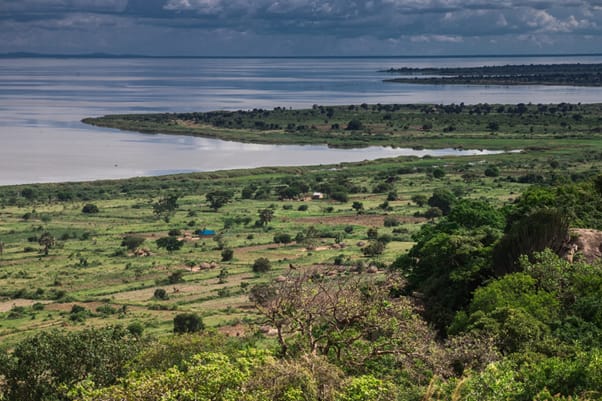
The viw from “the rooftop of Kwania”
Standing atop Got Agwiciri rewards you with the most beautiful view in all of Lango.
It is 360 degrees of panoramic, pure, unexpected splendour. The kind of view that interrupts your breath. The kind that makes you wonder why no one talks about this place. The kind that holds you still for a moment—just to appreciate the miracle of nature.
As you stand at the summit, a gentle breeze rises from Lake Kwania, climbing the rock to cool your body after the climb. The air has a fresh, sweet smell—untouched, unpolluted, unmistakably natural.
And if you brought binoculars?
This is the moment to pull them out.
Scan the horizon and you will spot:
The Bukungu rocks
The Nakasongola/Buruli rocks
The iconic Akokoro and Ibuje rocks
And even Got Kagaya in Kaberamaido
You will realise instantly why locals fondly call it “The Rooftop of Kwania.”
A Perfect Place for Picnics, Camping, or Corporate Retreats
Got Agwiciri is not just a rock. It is a perfect venue—almost made for:
Family picnics
Camping adventures
Corporate retreats
Team-building sessions
Friendship hangouts
Photography tours
Outdoor weddings and functions
If you want something naturally beautiful, unique, and utterly memorable—this is the place.
Because from the top, your eyes feast on a landscape painted by God Himself:
Endless shades of green from surrounding crop fields
A shoreline that curves and snakes like an artist’s brushstroke
Deep green field borders forming a natural patchwork
Fresh blue-green lake waters shimmering in the sun
A sky so blue, with clouds so white and fluffy, they look like floating cotton wool
If you are faint-hearted, the beauty might even push a tear or two down your cheek.
It is a quiet, gripping, profound moment—one you will never forget.
So if you are planning something special this festive season, I strongly encourage you:
Go and hike Got Agwiciri.
It is worth every step.
How to Reach Got Agwiciri
To visit this hidden treasure safely and easily:
Contact the Kwania District Tourism Office for directions and access support
The murram road to the rock is in good condition
If you would like a personal tour guide, feel free to reach out to me:
+256 751 227 228
A Small Request From Ongwen Laodog
Dear reader,
If you’ve been enjoying my stories — the humor, the history, the “from-the-ground-in-Lango” flavor — please consider supporting my work through a donation. Your contribution helps me spend more time digging up rare stories, taking unique photos, interviewing elders, and serving you those delicious cultural insights that mainstream media ignores.
I started Not Your Normal News to preserve the stories, language, and wisdom of Lango. Every edition is my way of connecting our elders’ voices, our heritage, and our innovations with Ugandans spread across the world. I try to tell these stories the Lango way: lightly, playfully, and honestly — just like we chat at the trading centre.
But to keep this work growing, I need your support. Funds help with equipment, travel, research, and production costs so I can keep bringing you the stories that would otherwise disappear.
I’m also available for personalized genealogy projects — for individuals or families. If you want your family tree documented in video or written form, I can help you trace your roots, interview your elders, and produce a beautiful family documentary.
Thank you so much for your support — financial, material, or even simply by reading every edition. It truly keeps this work alive.
Ongwen Laodog
email: [email protected]
Whatsapp: +256751227228
Mobile: +256785345614
1